Yeshiva
Beit Midrash
- Torah Portion and Tanach
- Shmot
- Pkudei

The Torah study is dedicatedin the memory of
Yaakov Ben Behora
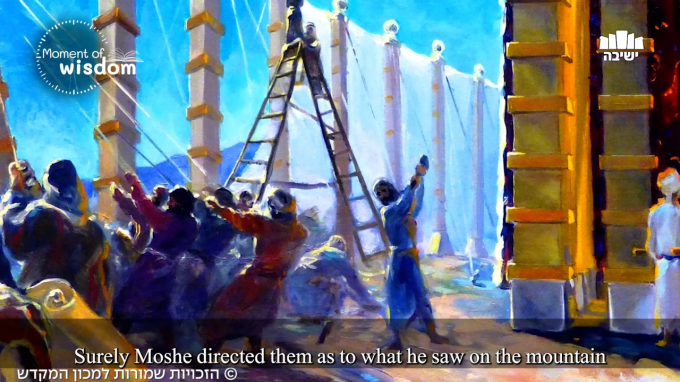
One factor, which Chazal discussed prominently, is that the Torah spelled out here a specific melacha to refrain from: "Do not burn fire in any of your inhabitations on the day of Shabbat." (Halachot are derived from this phenomenon (see Shabbat 70a), but they are not our focus in this context.) The other main factor is that it is mentioned directly before the commandment to prepare for the Mishkan’s construction. Chazal learn from the juxtaposition that the preparations were not allowed to compromise the complete observance of Shabbat.
On the other hand, within these same p’sukim, we have evidence that the Mishkan does supercede Shabbat. The gemara (Shabbat 20a) infers from the words, "in any of your inhabitations," that in the Mishkan, fire would burn on Shabbat, by putting portions of the sacrifices on the altar. The answer to this potential contradiction is straightforward. Bnei Yisrael were not allowed to violate Shabbat in the preparatory stages of the Mishkan but certain acts of worship were permitted even in a manner that would otherwise have been a desecration of Shabbat.
Questions, though, still remain. Can we learn anything from the fact that permission to offer sacrifices on the "fire" at the Mishkan on Shabbat surfaces at this point of the Torah. Should this not have been addressed in the sections describing the sacrifices? It is important to realize that Moshe had just assembled the whole nation to broach the subject of donations for the Mishkan. How would Moshe "market" the Mishkan? Why build one? Who would it serve?
Moshe used the interaction of Shabbat with the Mishkan and the activities therein as a litmus test. Activities that served Hashem directly might be allowed to be performed on Shabbat. Indeed, certain korbanot meet the criterion, and so Moshe could tell the people, "Take from yourselves a donation to Hashem" (Shemot 35:5). On the other hand, Bnei Yisrael should not look at the whole project as some sort of favor for Hashem. The people should know that they were not building a "home" for Hashem because He lacked living space in the Heavens (see Melachim I, 8:27). Rather, it was a means for the nation to have more palpable and direct contact with Hashem (Shemot 25:8). As such, the Mishkan was built for the nation’s use and should not be done on Shabbat.
It is important to be willing to sacrifice in order to serve Hashem in the proper manner. However, it is also important to realize that when we give of ourselves, we are receiving at the same time. Whether we "give" to Hashem or even to our fellow man, we are giving ourselves the gift of nobility and true fulfillment at the same time. We certainly should not have the attitude that since we are giving, we have the right to "cut corners" in other ways.








Rabbis in Midrash























Lessons
fast navigation











Hosha'ana Rabba FLYDUBAI & HOSHANA RABBA- ANI VAHU HOSHIA NA- I & HIM SAVE US
"Ani vaHu Hoshia Na", "I and Him, Save Us". We don't just pray to Him, but we also pray to and for ourselves that we should emulate and educate our children to have that instinctive altruism with which He created the world. President Trump seemed amused about Yaniv Hayon, our PLUMBER who confidently worked with G-d like Superman (he learned from a pilot on a TV show!) to save 174 lives on the Dubai hijacking, but we in Israel are totally accustomed already 78 years to our plumbers, teachers, garbage-men, rabbis, farmers & doctors being Hashem's shlichim! This is what Zionism is about.











