Yeshiva
Beit Midrash
- Shabbat and Holidays
- Hanukkah
- The Meaning of Hanukkah

Surrounded by enemies meant to destroy the Jewish state and faith, and beset by a substantial amount of internal enemies willing to become Greeks, the Hasmoneans fought both enemies strongly and successfully. But they were fortunate that in the second century before the Common Era there were no NGOs, EUs, no media bias and a plethora of do-gooders.
The Hasmoneans would undoubtedly have been accused of war crimes, aggression, and of becoming occupiers of the land that in truth belonged to them. However, their timing was impeccable. By current day standards, there could never be a Chanuka holiday. This is not to say that hypocrisy and double dealing did not exist in the days of the Hasmoneans. Human nature has not changed significantly since Adam and Eve were driven from the Garden of Eden.
However, with the development of civilization, technology and the wide dissemination of information – both true and false- we must agree that the implementation of hypocrisy and false and unfair judgment has reached a new high in our time. And unfortunately, our small state and great people are the primary victims of this new, exalted perfidy.
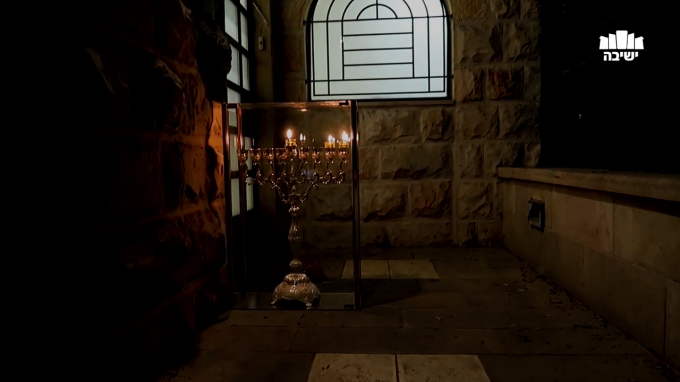
Perhaps the Rabbis of Old, when establishing the holiday of Chanuka, realized that there would rise a later generation, Jewish and non-Jewish, that would not be proud of the courage and fortitude of the Hasmoneans. There would arise a generation that would have preferred that the Hasmoneans engage the Greeks rather than defeat them in battle. Perhaps this is why the Rabbis chose to emphasize the miracle of the light of the oil lamp as the basic theme and commandment of Chanuka.
It is hard to find fault with a small flame that somehow burned miraculously for eight days when it had only sufficient fuel for one day. This miracle of the small flame came to justify the entire epic of the Hasmonean struggle against the Greeks and against the Hellenists. If the Hasmoneans were in fact wrong in conducting their struggle against the Greeks in a forceful fashion, then the Lord would not have provided the miracle of the flame.
The rededication of the Temple and its purification from pagan defilement was again another indication of the correct struggle of the Hasmoneans, of their tactics, and behavior. The preservation of the Jewish people and of Torah values within that people is the ultimate strategic goal of our nation since the time of Abraham. This goal has not changed in our time and, in fact, all current events have brought it into sharper focus. This is the central issue which dwarfs all others in Jewish society and worldview.
The Rabbis framed one of the blessings over the lights of Chanuka as recognizing the events ‘bayamim hahem,’ in those days’ bazman hazeh,’ in our time. We always have to look at how past events play themselves out in the current scene. We have to make certain that national errors and wrong policies that were present ‘bayamim hahem,’ in past times, do not repeat themselves ‘bazman hazeh,’ in our current time.
And, we also have to be aware that the wisdom, traditions, and good sense of the past not be easily discarded by current fads and transient mores in order to fit ourselves into a perceived modern, politically correct time. This balance between the past and the present, between what was and what is remains the challenge of our generation.
Discarding our past has proven to be spiritually and even physically fatal to millions of Jews over the last centuries. And, ignoring the realities of the present, handicaps us in dealing with the problems and the struggles that we must yet endure. The lights of Chanuka serve to remind us that at one and the same time we live ‘bayamim hahem,’ in those past days and ‘bazman hazeh,’ in our current world as well. The flames of Chanuka have survived for almost 23 centuries and remain the inspiration for our faith in our eventual achievement of Jewish sovereignty in our holy land and in the expansion of our spiritual values, Torah knowledge and observance.








Rabbis in Midrash























Lessons
fast navigation









Hosha'ana Rabba FLYDUBAI & HOSHANA RABBA- ANI VAHU HOSHIA NA- I & HIM SAVE US
"Ani vaHu Hoshia Na", "I and Him, Save Us". We don't just pray to Him, but we also pray to and for ourselves that we should emulate and educate our children to have that instinctive altruism with which He created the world. President Trump seemed amused about Yaniv Hayon, our PLUMBER who confidently worked with G-d like Superman (he learned from a pilot on a TV show!) to save 174 lives on the Dubai hijacking, but we in Israel are totally accustomed already 78 years to our plumbers, teachers, garbage-men, rabbis, farmers & doctors being Hashem's shlichim! This is what Zionism is about.
Moreshet Shaul Hashem Is your Shadow – part I
Based on Siach Shaul, Pirkei Machshava V’Hadracha p. 420 – an address from 1941









