Yeshiva
Beit Midrash
- Shabbat and Holidays
- The Three Weeks
- The 17th of Tamuz

Translated by Hillel Fendel
A day of fasting in the Jewish calendar – such as this Sunday's Fast of Tammuz – is not one of dieting, but rather a day of introspection and teshuva (contrition and remorse). We are not fasting for something far-removed from ourselves, but rather for our situation this very day: Yes, the beginning of the destruction of Jerusalem and the Holy Temple began on this day some 1,950 years ago – but have the breached walls yet been rebuilt? Has the Holy Temple service been renewed? No – and so we must draw the appropriate conclusions.
During the "regular" days of the year, our minds are not free to examine the course of our personal and public lives, to see if they meet our ambitions and goals. A day of fasting is the perfect opportunity to do so – a day to contemplate the direction in which our daily actions appear to be leading us.
We know that the climactic moment of a Jewish wedding is the breaking of a glass, in memory of our as-yet unrebuilt Holy Temple. For it is specifically on our joyous occasions, when our hearts overflow with happiness, that we should stop for a moment, halt our dancing, and ask: What exactly are we so happy about?
Every Jewish simcha (joyous occasion) is actually mixed with some sadness. Our joys are not times for simply letting loose, but are rather serious and deep. Superficiality and light-headedness are not the hallmarks of true happiness, nor do they have anything to do with giving thanks and appreciation of what we have. We need, like the air we breathe, some days each year of seriousness for contemplation and thought regarding the future to which our present is taking us.
Let us consider this day of the 17th of Tammuz. As mentioned, the walls breached on this date by the Romans have never been rebuilt. Not that "rebuilt walls" are the ideal; the prophet Zecharia foresaw that "Jerusalem shall be like unwalled towns" because the multitude will not be able to fit inside the walls. In addition, who needs walls when we have no need to fear our enemies?
But actually, we will still require walls around Jerusalem because of the sanctity they enclose: Only within the walls can we eat the Paschal sacrifice and other holy foods. We require priests, Urim v'Tumim, Sanhedrin, prophecy and more in order to sanctify the walls of Jerusalem – yet where are all these? They are still sorely lacking!
The very thought of eating on this day, then, is a non-starter – for it would be a mockery of all our national ambitions and destiny! The rebuilding of holy Jerusalem is dependent not only on G-d, but also upon our readiness of heart, spiritual ascent, removal of partitions, great faith, and strength of spirit. For with our very eyes we saw [particularly in the Six Day War] how the Redemption combines both human actions and Divine guidance!
On this day, the Mishna tells us, the daily Tamid sacrifice was abolished. Has it been renewed yet? Of course not!
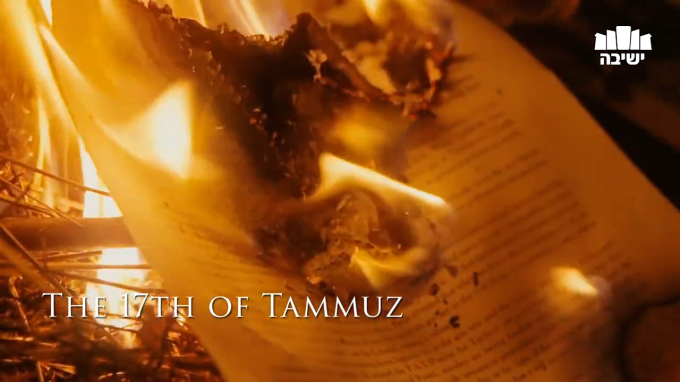
On this day, the Torah was burnt. Does it not continue to be burnt even now by Gentiles, and even sometimes – to our tremendous sorrow and shame – by our own precious Jewish brethren, here in our Land even as it continues to be redeemed?
On this day, the Tablets of the Law were broken when the Israelites danced around the Golden Calf. Has this sin disappeared? Have sinners ceased shattering our Tablets?
On this day an idol was placed in the Sanctuary. Yet another form of this very idol, in the form of a golden dome, still stands there, proudly towering above the ruins of our unbuilt Sanctuary. And this, even as some of our political leaders continue to leave the door open for negotiations to expropriate it from our control and give it for free to the foxes traipsing there. And we stand by, on the side, defiled and distanced, sighing and crying as we await our deliverance.
On this day, we must ask: Do we truly sense the insult to the Divine Presence and its sorrow at this state of affairs? Is it too much to expect that we stop eating on this day? Why does our heart not explode, why does our blood not boil, at the defeatist attitude of many in our nation regarding our holy borders to which we were miraculously privileged to return?
And thus, with this knowledge of what we are fasting for, may this be our final day of fasting, and may we see the Rebuilding of Jerusalem, speedily in our days!
In order to get articles like this delivered straight to your inbox every week, subscribe to the Israel National Torah newsletter here.
A day of fasting in the Jewish calendar – such as this Sunday's Fast of Tammuz – is not one of dieting, but rather a day of introspection and teshuva (contrition and remorse). We are not fasting for something far-removed from ourselves, but rather for our situation this very day: Yes, the beginning of the destruction of Jerusalem and the Holy Temple began on this day some 1,950 years ago – but have the breached walls yet been rebuilt? Has the Holy Temple service been renewed? No – and so we must draw the appropriate conclusions.
During the "regular" days of the year, our minds are not free to examine the course of our personal and public lives, to see if they meet our ambitions and goals. A day of fasting is the perfect opportunity to do so – a day to contemplate the direction in which our daily actions appear to be leading us.
We know that the climactic moment of a Jewish wedding is the breaking of a glass, in memory of our as-yet unrebuilt Holy Temple. For it is specifically on our joyous occasions, when our hearts overflow with happiness, that we should stop for a moment, halt our dancing, and ask: What exactly are we so happy about?
Every Jewish simcha (joyous occasion) is actually mixed with some sadness. Our joys are not times for simply letting loose, but are rather serious and deep. Superficiality and light-headedness are not the hallmarks of true happiness, nor do they have anything to do with giving thanks and appreciation of what we have. We need, like the air we breathe, some days each year of seriousness for contemplation and thought regarding the future to which our present is taking us.
Let us consider this day of the 17th of Tammuz. As mentioned, the walls breached on this date by the Romans have never been rebuilt. Not that "rebuilt walls" are the ideal; the prophet Zecharia foresaw that "Jerusalem shall be like unwalled towns" because the multitude will not be able to fit inside the walls. In addition, who needs walls when we have no need to fear our enemies?
But actually, we will still require walls around Jerusalem because of the sanctity they enclose: Only within the walls can we eat the Paschal sacrifice and other holy foods. We require priests, Urim v'Tumim, Sanhedrin, prophecy and more in order to sanctify the walls of Jerusalem – yet where are all these? They are still sorely lacking!
The very thought of eating on this day, then, is a non-starter – for it would be a mockery of all our national ambitions and destiny! The rebuilding of holy Jerusalem is dependent not only on G-d, but also upon our readiness of heart, spiritual ascent, removal of partitions, great faith, and strength of spirit. For with our very eyes we saw [particularly in the Six Day War] how the Redemption combines both human actions and Divine guidance!
On this day, the Mishna tells us, the daily Tamid sacrifice was abolished. Has it been renewed yet? Of course not!
On this day, the Torah was burnt. Does it not continue to be burnt even now by Gentiles, and even sometimes – to our tremendous sorrow and shame – by our own precious Jewish brethren, here in our Land even as it continues to be redeemed?
On this day, the Tablets of the Law were broken when the Israelites danced around the Golden Calf. Has this sin disappeared? Have sinners ceased shattering our Tablets?
On this day an idol was placed in the Sanctuary. Yet another form of this very idol, in the form of a golden dome, still stands there, proudly towering above the ruins of our unbuilt Sanctuary. And this, even as some of our political leaders continue to leave the door open for negotiations to expropriate it from our control and give it for free to the foxes traipsing there. And we stand by, on the side, defiled and distanced, sighing and crying as we await our deliverance.
On this day, we must ask: Do we truly sense the insult to the Divine Presence and its sorrow at this state of affairs? Is it too much to expect that we stop eating on this day? Why does our heart not explode, why does our blood not boil, at the defeatist attitude of many in our nation regarding our holy borders to which we were miraculously privileged to return?
And thus, with this knowledge of what we are fasting for, may this be our final day of fasting, and may we see the Rebuilding of Jerusalem, speedily in our days!
In order to get articles like this delivered straight to your inbox every week, subscribe to the Israel National Torah newsletter here.






Rabbis in Midrash























Lessons
fast navigation











Hosha'ana Rabba FLYDUBAI & HOSHANA RABBA- ANI VAHU HOSHIA NA- I & HIM SAVE US
"Ani vaHu Hoshia Na", "I and Him, Save Us". We don't just pray to Him, but we also pray to and for ourselves that we should emulate and educate our children to have that instinctive altruism with which He created the world. President Trump seemed amused about Yaniv Hayon, our PLUMBER who confidently worked with G-d like Superman (he learned from a pilot on a TV show!) to save 174 lives on the Dubai hijacking, but we in Israel are totally accustomed already 78 years to our plumbers, teachers, garbage-men, rabbis, farmers & doctors being Hashem's shlichim! This is what Zionism is about.













