YeshivaThe torah world Gateway
Beit Midrash
- Jewish Laws and Thoughts
- Jewish Thought
- Foundations of Faith

The Torah study is dedicatedin the memory of
Yaakov Ben Behora
The Rabbi does a wonderful job of outlining such a personality before the Khazar king. The Hassid, he explains, is a man of faith, actual living faith. Not mere intellectual, theoretical faith, but concrete living faith. Wherever he looks, he sees God. He sees the wonderful workings of nature, and they are full of God's wisdom.
He looks at himself, his own body, at the wonderful workings of the human body, the nervous system, the blood, digestion, muscles. Many books have been written about the human body, its complex and fantastic resources. It is God who has created man with such wisdom. The Hassid looks at himself and is awed by God's wisdom. He says, "from my flesh I can see God" (Job 19:26).
Foundations of Faith (51)
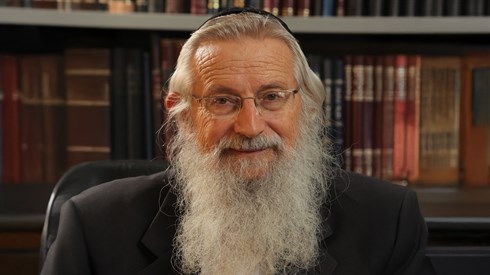
Rabbi Zalman Baruch Melamed
46 - 47. The “Hassid” - The Ideal Jew
47 - 48. More about the Ideal Jew
48 - 49. True Faith Brings Trust in God
Load More
In the time of the ancients, the practice was that before entering the bathroom one would say, "Be honored, my revered ones." That is, they would say to the accompanying angels, "Excuse me please. Wait here outside while I relieve myself, be honored and wait here for me to return." Something of this practice still exists today in the custom to sing "Shalom Aleikhem Malakhei HaSharet" ('Peace upon you, O ministering angels") on Sabbath evening upon returning home from the Synagogue. We do this because two ministering angels accompany the Jew home from the Synagogue on Sabbath evening.
These customs - "Be honored, my revered ones" and "Shalom Aleikhem" - evidence the fact that Israel is accompanied by angels, "for His angels has He instructed concerning you, to protect you on your every path." Incidentally, the question arises as to why the practice to say "Be honored, my revered ones" was discontinued while the "Shalom Aleikhem" custom continued. If it is no longer proper to say "Be honored, my revered ones" because we are not important enough to be accompanied by angels (as the commentators explain), why do we continue to sing "Shalom Aleikhem"?
Rabbi A.Y. HaCohen Kook explains that the custom to say "Be honored, my revered ones" was due to the fact that at that time Jews would wear tefillin (prayer phylacteries), and by virtue of the tefillin, the angles would provide accompaniment. Today, however, Jews only wear tefillin during morning prayers, and therefore angles do not accompany us and there is no need to say "Be honored, my revered ones." The Sabbath, however, is itself a kind of sign, a reminder, like tefillin, and therefore, by merit of the Sabbath, angels even today accompany the Jew home from the Synagogue, and we sing "Shalom Aleikhem."
Getting back to the matter of the Hassid. Such a person leads a life of attachment to God, he places tefillin on his head and arm in relation to his brain and heart, and they serve as a sign, recalling God's unity and the Exodus from Egypt. He wears tzitzi'ot (tassels) which serve to remind him of all the Divine commandments, and to warn him and not to stray after his heart, as it is written, "that you seek not after your heart and your eyes, which incline you to go astray" (Numbers 15:39), and he serves God joyfully all the days of his life.





Rabbis in Midrash























Lessons
fast navigation








Moreshet Shaul Hashem Is your Shadow – part I
Based on Siach Shaul, Pirkei Machshava V’Hadracha p. 420 – an address from 1941

P'ninat Mishpat A Non-Contractor in Changing Times – part I
(based on ruling 85128 of the Eretz Hemdah-Gazit Rabbinical Courts)
Moreshet Shaul Our King on Rosh Hashana, Our Father on Yom Kippur.
Based on Aroch Siach, p. 221 (Rav Shaul Yisraeli)
P'ninat Mishpat A Non-Contractor in Changing Times – part II
(based on ruling 85128 of the Eretz Hemdah-Gazit Rabbinical Courts)
Moreshet Shaul Hashem Is your Shadow – part II
Based on Siach Shaul, Pirkei Machshava V’Hadracha p. 420 – an address from 1941
Parashat Hashavua Happiness for the Right Reasons
[With painful longing, we share these divrei Torah from our co-Rosh Kollel for close to 40 years, Harav Moshe Ehrenreich zt”l.]