Yeshiva
Beit Midrash
- Sections
- Chemdat Yamim
- Ein Ayah
- Jewish Laws and Thoughts
- Rav Kook books
- Ein Aya

Ein Ayah: Hashem created man in a way that he is fit to seek wisdom, and being happy and at ease when studying Torah is fundamentally appropriate. However, man is no longer in his pure state because of his sins and the sins of his parents, resulting in the desire for knowledge being replaced by desires of lowly external matters. Therefore, when one begins to study Torah, he usually has to overcome obstacles stemming from his coarse nature instead of being able to experience joy alone.
It is fine to have to toil, for which man is born (Iyov 5:7). Once we have sanctified ourselves sufficiently in the ways of Torah, we return to the original natural state at which Torah study is pleasant. It is a mistake to try to make all levels of learning, including for beginners, fun. It is not through fun that a wild spirit turns into a scholar, but it is the Torah that one learns with hard work that does this (see Yalkut Shimoni, Kohelet 2). It is nice to learn Torah in a state of happiness, but one should not make it a priority, as it has only an external connection to wisdom, and it can come at a later stage. If one sees it as something to seek at an early stage, then it trains him to avoid the type of toil and search for truth that should characterize earlier stages. The divine gift of deriving joy from Torah study is reserved for those who have put in the work and familiarized themselves with the sweet light of truth.
Heat is a very useful force in the world, but it is destructive for he who tries to use it at the wrong time and manner. Similarly, a beginner student who still needs his teacher to expose him to the truth of Torah must have a measure of bitterness on his lips, for if he is looking just for pleasantness, then he will be burnt from the process. The idea of burning is appropriate from the perspective of approaching the "fire of Torah" in an inappropriate way. This will cause him to lose the possible intellectual/spiritual development that could have brought him true joy if he had acquired it at the right time.
A rose is the most beautiful of flowers. It excites the external sense of vision. The grandeur of wisdom and enjoyment that it can bring are pleasant. However, it is not external beauty that is important but the acquisition of internal good, such as grasping truth, which is represented by mor (a perfume), which impacts a person’s soul. The student who is beginning must know to concentrate on the internal and the depth of Torah and be ready to give up much comfort for that purpose. This is "mar over" (passing bitterness). If one tastes the bitterness, it will be passing, and he will merit that the wisdom will cause him great pleasantness and joy. This is on condition that he does not view the words of Torah as songs (see Sanhedrin 101a) and does not demand that they be entertaining from the beginning in a childish manner. Through toil and hard work in the beginning one arrives at great light and an area surrounded by rosebushes. Even in the beginning, it is only the lips, i.e., the external part, that experiences the bitterness, which one should accept with love. Internally, the soul benefits immediately from the efforts to acquire wisdom, as the pasuk says: "It is good for me for I have afflicted myself to learn Your statutes" (Tehillim 119:71).





Rabbis in Midrash























Lessons
fast navigation







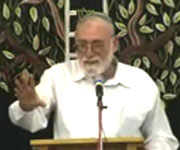



Hosha'ana Rabba FLYDUBAI & HOSHANA RABBA- ANI VAHU HOSHIA NA- I & HIM SAVE US
"Ani vaHu Hoshia Na", "I and Him, Save Us". We don't just pray to Him, but we also pray to and for ourselves that we should emulate and educate our children to have that instinctive altruism with which He created the world. President Trump seemed amused about Yaniv Hayon, our PLUMBER who confidently worked with G-d like Superman (he learned from a pilot on a TV show!) to save 174 lives on the Dubai hijacking, but we in Israel are totally accustomed already 78 years to our plumbers, teachers, garbage-men, rabbis, farmers & doctors being Hashem's shlichim! This is what Zionism is about.
Moreshet Shaul Hashem Is your Shadow – part I
Based on Siach Shaul, Pirkei Machshava V’Hadracha p. 420 – an address from 1941
P'ninat Mishpat A Non-Contractor in Changing Times – part I
(based on ruling 85128 of the Eretz Hemdah-Gazit Rabbinical Courts)








