Yeshiva
Beit Midrash
- Sections
- The Life of Tzaddikim
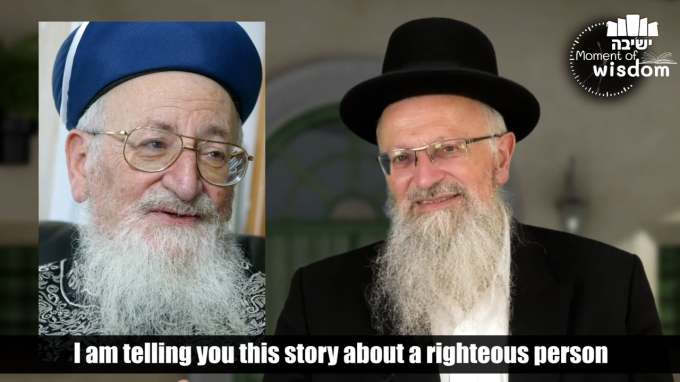
- Rabbi Mordechai Eliyahu

My brother Mordechai asked that the shoes would be a little too big, so that he could wear them for a long time. He said to our mother that he was then at the stage of rapid growth and so it made sense to buy bigger shoes, and he would stuff them with paper so they wouldn’t be loose on his feet.
After a while the shoemaker notified us that the shoes were ready. Together with Mordechai, my mother went to the shoemaker, paid him half a lira and took the shoes. Mordechai was delighted with them.
Later, Mordechai went out into the street and saw the mother of one of the Yeshiva students crying.
"Why are you crying?" he asked her.
"Because my son doesn’t want to go to Yeshiva! He doesn’t have any decent shoes and he refuses to go in torn shoes," she replied.
"I’ll give him mine," Mordechai offered.
"But he’s bigger than you and your shoes will be too small for him," the mother said.
Mordechai didn’t hesitate and replied, "These shoes are a few sizes too big for me so they should fit your son."
He ran home to get his old shoes, packed up the new shoes and brought them to the student’s mother. Indeed, the shoes fitted him perfectly, and he agreed to go to the Yeshiva to study.
In the evening, my mother noticed Mordechai polishing his old shoes.
"Why are you polishing them?" she asked, and he told her the story.
My mother was very pleased with her son’s good character traits and told him, "You’ll get new shoes anyway!" She took him to the shoemaker and asked him to make him another pair of shoes.
"What happened?" the shoemaker, the father of Rabbi Abba Shaul, asked in surprise. "Just yesterday you got new shoes – where are they?"
My mother explained what had happened, and the shoemaker, who understood what a high level of generosity had been displayed by such a small child, told her that he was prepared to forgo his profit and sell her the shoes for thirty five agurot, the cost of the materials only.






Rabbis in Midrash























Lessons
fast navigation











Various Events FOR WHOM NOT TO VOTE
Rav Zvi Yehuda Kook stressed that Israeli politics is G-dly, so I have no problem answering this common question on a Torani blog. Also, Free-Will is a G-d-given right and obligation, to "destine one's fate" (R. Soloveichik, Kol Dodi Dofek, 67), so I obviously don't tell others how to vote. But once not a few (especially young) have already asked, a couple of personal words from experience and thoughts from chazal & Rav Kook which may be of help to others, mainly for whom NOT to vote.
P'ninat Mishpat Fallout from Failure to Install Elevator – part II
based on ruling 85007 of the Eretz Hemdah-Gazit Rabbinical Courts









