Yeshiva
Beit Midrash
- Sections
- Chassidish Stories and Great Rabbis
- Additional Stories

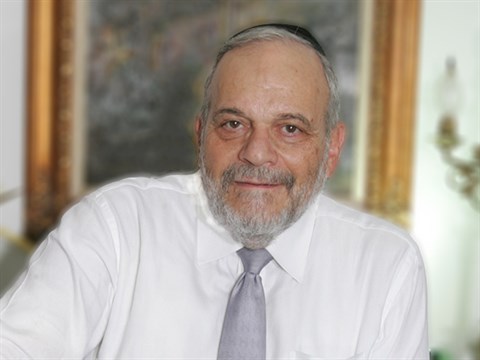
The conference was attended by a large and diverse audience and the presentations were of high caliber and most interesting and informative. But this article is not so much about techelet, blue dye, indigo or royal purple coloring, as it is about the author of that thesis, one of the great rabbis of the past century who in my opinion has never been given his proper due in the Torah or general world of our time.
There are probably many reasons for this lack of knowledge and approbation about him and his accomplishments. But I feel that the main reason for this is that he was much too unique, different, out-of-the-box, apolitical, fearless in his views and decisions while at the same time being humble, self-effacing and modest to the extreme in his personal and private life.
For various reasons, psychological, theological and historical, the Jewish "establishment" world does not easily tolerate such people. They make us "normal" people, conditioned by dogma, preconceived notions and societal conformity, uncomfortable, and they force us to think. And, that can be a painful experience.
Rabbi Herzog was a linguist, having a grasp of a dozen languages including many ancient ones such as Sumerian and Acadian as well as the classical Greek and Latin. He was a biblical scholar of note, a Hebrew grammarian and a scholar of Talmud, rabbinic writings and halachic decisions, of enormous proportions. His memory and genius were of a prodigious nature.
He also explored the sciences such as zoology, botany, astronomy, physics and chemistry with diligence and perspective. But his main passion, intellectual, emotional and commitment wise, was Torah in all of its variety and ramifications. His many volumes of response as well as his opinions on halachic issues and cases brought before the High Court of the Chief Rabbinate here in Israel during his years as its head judge and Chief Rabbi are a treasure trove of Torah erudition, hard-headed logic and a practical and yet compassionate worldview of life, people and Jewish society.
Worldlier than his predecessor Rav Kook, Rav Herzog was the Chief Rabbi during one of the most turbulent and decisive times in Jewish history - from 1936 to 1959. He saw the Jewish world destroyed and rebuilt during his tenure in office. He never flinched or faltered in front of the pressures exerted upon him by the non-Jewish world generally, the Catholic Church particularly, the then avowedly and militantly secular Zionist leadership of the emerging state, the violent zealots of Jerusalem who opposed him without truly knowing him, the British rulers of the country and the complexities of being the Chief Rabbi for hundreds of rabbis of different personalities, ideologies and ambitions. His gentle personal nature belied his iron determination and stubborn love for Torah and the Jewish people.
The Chief Rabbinate of Israel today is no longer that of Rav Kook or Rav Herzog. Though always subject to political competition – Rav Herzog had to defeat Rav Charlop in a hard fought election campaign in 1936 to become the Chief Rabbi – it has further deteriorated now, becoming seen as almost a purely political office instead of being one of spiritual vision and national leadership.
The recent unfortunate scandals that have surrounded the office have only further diminished its original luster. There is always nostalgia present when looking back at previous generations and their leaders. Yet I believe that no one would disagree as to the statement that the Chief Rabbinate of Israel has never again achieved the dignity and widespread support of all sections of the Jewish world that it had during the tenure of Rabbi Herzog.
And we are all the poorer because of this decline of an important institution in Israeli and Jewish life. The Talmud teaches us that superior people are not an easily found commodity. Therefore the Lord, so to speak, scattered them throughout the ages and implanted them in certain separate generations. Rabbi Herzog was such a superior person implanted by God at a special time and in a special generation of Jewish history. His contributions to Jewish scholarship, life and rebirth remain today and we are all in his debt.






Rabbis in Midrash























Lessons
fast navigation










Hosha'ana Rabba FLYDUBAI & HOSHANA RABBA- ANI VAHU HOSHIA NA- I & HIM SAVE US
"Ani vaHu Hoshia Na", "I and Him, Save Us". We don't just pray to Him, but we also pray to and for ourselves that we should emulate and educate our children to have that instinctive altruism with which He created the world. President Trump seemed amused about Yaniv Hayon, our PLUMBER who confidently worked with G-d like Superman (he learned from a pilot on a TV show!) to save 174 lives on the Dubai hijacking, but we in Israel are totally accustomed already 78 years to our plumbers, teachers, garbage-men, rabbis, farmers & doctors being Hashem's shlichim! This is what Zionism is about.
Moreshet Shaul Hashem Is your Shadow – part I
Based on Siach Shaul, Pirkei Machshava V’Hadracha p. 420 – an address from 1941











