Yeshiva
Beit Midrash
- Torah Portion and Tanach
- Shmot
- Tetzave
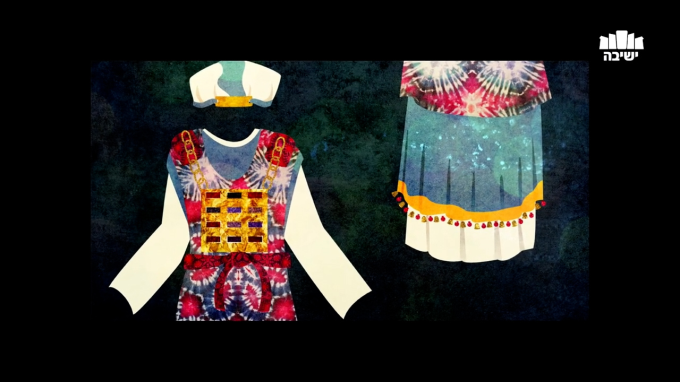
The weekly Torah portions in which Moshe is instructed how to build the Mishkan are Terumah and Tetzaveh, the latter of which we read this week: Sh'mot 27,20 – 30,10). The first portion deals with the Mishkan itself and the Menorah, Table, Ark, and Altar, while Tetzaveh details the Priestly Garments. However, Tetzaveh begins with something seemingly unconnected: the Divine command that Israel bring oil for the Menorah, and another directive to Aharon and the Priests to light it every evening.
The Ha'amek Davar and others ask: Why does the lighting of the Menorah interrupt between the Mishkan and the Priestly Garments?
As is known, the Gemara tells us that the Menorah was not needed to physically illuminate the Mishkan, but rather to "attest to the entire world that G-d's presence is within Israel" (Tr. Shabbat 22b). G-d promised that He would dwell in our midst (Sh'mot 25,8), within every Jew. But the Torah emphasizes that His presence dwells also on items that appear to be technical and external – such as even the clothing that the Priests must wear as they perform the Temple service. For "the heart follows the actions," we learn in the Sefer HaChinukh, mitzvah number 16.
And this is actually the mission of the Cohen. The saintly Rav Kook writes (Orot HaT'chiyah 4) that the purpose of the Priesthood is to come "from within the children of Israel" – the Priests must use their sanctity to raise our regular daily routines to even higher levels. This is also the mission of all of Israel, which is charged to be a "kingdom of Priests and a holy nation" (Sh'mot 19,6) in comparison with the other nations.
Rav Kook writes a similar idea regarding the Pesach-night Seder: "This is why we eat, on this holy night, a simple vegetable called karpas, whose function is to arouse our appetites – because on the Seder night, we need not fear that we will become over-involved in unrestrained eating, because the night's holiness will overcome it."
This connects with Purim as well. The Gemara suggests that a Torah source for the wicked Haman [who lived some 13 centuries after the Torah was given] is in the following verse: "Hamin – Did you [Adam] in fact eat from the tree I commanded you not to eat from?" (B'reshit 3,11) The profundity of this point is as follows:
By eating from the forbidden Tree of Knowledge, simply because it was "good to eat and attractive to the eyes" (3,6), Adam and Eve fell into the trap of sinful lust. This was also the sin of Haman's ancestor Esav, who demanded that Yaakov give him some of his porridge (25,30). Yaakov, on the other hand, lusted only for the spiritual – the priestly privileges of the first-borns. [The Cohanim took over the Temple service from the first-borns.]
Similarly, on Purim the Jews were punished for having taken part in the feast of King Achashverosh, following their eyes towards that which was only of external value. The rectification of this sin is the mitzvah that we fulfill on Purim of eating a festive meal that is replete with spirituality, devotion to G-d, and sanctification of the physical.
When Yaakov went to his father to receive the blessings that would otherwise have gone to Esav, Yitzchak smelled Yaakov's clothing, which belonged to Esav, and said, "See, my son's fragrance is like the perfume of a field blessed by G-d" (B'reshit 27,27). Yitzchak smelled the aroma of Gan Eden (Paradise) in the garments, and the Gemara says that this indicates that even the most "empty" Jew is replete with good deeds.
The Targum Yonatan explains that the aroma was that of the Temple incense (ketoret). The idea behind this is that Esav was the ancestor of Haman, who "knew how to speak evil and gossip better than anyone" (Megillah 13b), and yet his clothing were like the ketoret, which atones for exactly that sin. Why? Because both the ketoret, which is offered in the all but inaccessible Holy of Holies, and evil speech are done in secret: "Let that which is done in secret atone for that which is done in secret" (Tr. Zevachim 88b).
Mordechai also symbolizes the ketoret; see Onkelos to Sh'mot 30,23, and Tr. Hulin 139b. As such, the Jews who bowed to a graven image at Haman's command did so only externally (Megillah 12a). On Purim, the inner truth is revealed – as we read in Shir HaShirim (3,6): "Who is that who ascends from the desert… perfumed (mekuteret) with myrrh and frankincense" - even the bitter myrrh is a part of the ketoret, symbolizing that even the sinners of Israel are a part of Israel, as they are replete with mitzvot.
May G-d grant that we truly see how every Jew, even one who appears outwardly to be a sinner, is as full of mitzvot as a pomegranate. And may we merit to receive the genuine holiness of Purim!
Translated by Hillel Fendel
In order to get this Shiur every week directly to your Inbox, click here









Rabbis in Midrash


































Hosha'ana Rabba FLYDUBAI & HOSHANA RABBA- ANI VAHU HOSHIA NA- I & HIM SAVE US
"Ani vaHu Hoshia Na", "I and Him, Save Us". We don't just pray to Him, but we also pray to and for ourselves that we should emulate and educate our children to have that instinctive altruism with which He created the world. President Trump seemed amused about Yaniv Hayon, our PLUMBER who confidently worked with G-d like Superman (he learned from a pilot on a TV show!) to save 174 lives on the Dubai hijacking, but we in Israel are totally accustomed already 78 years to our plumbers, teachers, garbage-men, rabbis, farmers & doctors being Hashem's shlichim! This is what Zionism is about.










