Yeshiva
Beit Midrash
- Family and Society
- Shmitta
- The Torah Perspective
- Torah Portion and Tanach
- D'varim
- Nitzavim

Sometimes we have the impression that the days’ certain set place in the year, with their special practices of the day, repeated yearly, is the end of the story. The same admissions of guilt, the same prayers we prayed last year and two years ago, and hopefully next year etc. In the process, we try to ensure that these practices will not bother our routine – it shouldn’t ruin our eating habits, our leisure, and our travels. The days should just have their uniqueness within the tapestry of the year and add some freshness to our gray lives.
However, this is not the idea. In contrast to the language used by the korbanot of other holidays, it says regarding Rosh Hashana "va’asitem olah" (you should make a burnt offering), from which Chazal learned that it is as if a person redid himself. How can we remake ourselves if we want to keep our old routine? When Hashem asked that we say the section of prayers called malchuyot to "coronate Me over you," the idea was not to settle for speaking the words; there should be practical consequences from this coronation.
The goat that went to Hashem and the one that went to azazel (thrown off a cliff to its death) on Yom Kippur represent two conflicting approaches that emanate from one place. On the one hand, there is an idea of definiteness, and, on the other hand, an idea that it is impossible for everything to merge into one. That which is to Hashem, is to Hashem; that which is to idol worship, is to idol worship; the two cannot join. If one has chosen the direction of azazel, then even if he managed to do some mitzvot, based on habit, education, or societal norms, he is still on a path of destruction. The yetzer hara tells one to do one aveira one day and another on another day until he adopts idol worship (Shabbat 105b), as we see in our lives.
A person should admit his sins with the words "I was in a bad way" (Vayikra Rabba 3:3). R. Yonachan ben Zakai bemoaned his predicament, not knowing if he was headed to an after-life of attainment or tragedy (Berachot 28b). How terrifying it is that even a great, righteous leader does not know the lot he deserves. The mitzvot he performed might have been on a crooked path, and path is critical.
The solution is to accept Hashem as King. Hashem’s kingdom is in the way He rules the world, using His thirteen attributes, and His coronation is by accepting that as a clear fact. It is in knowing that Hashem determines everything, which is a life-altering realization. One accepts Hashem’s Kingdom by acting with fear of Hashem. It is a trait of a king that he must be feared and may not relinquish his rights to that awe (Ketubot 17a). The expression of the fear is in realizing that the world is not left to chance, but that matters are determined through divine justice. Therefore we set for ourselves what we deserve, as Hashem decides based on divine justice based on our actions, and this is how we make Him the King.
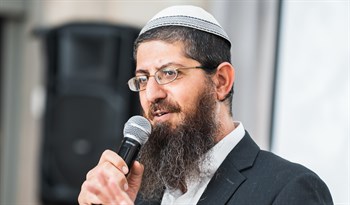




Rabbis in Midrash






















Lessons
fast navigation











Hosha'ana Rabba FLYDUBAI & HOSHANA RABBA- ANI VAHU HOSHIA NA- I & HIM SAVE US
"Ani vaHu Hoshia Na", "I and Him, Save Us". We don't just pray to Him, but we also pray to and for ourselves that we should emulate and educate our children to have that instinctive altruism with which He created the world. President Trump seemed amused about Yaniv Hayon, our PLUMBER who confidently worked with G-d like Superman (he learned from a pilot on a TV show!) to save 174 lives on the Dubai hijacking, but we in Israel are totally accustomed already 78 years to our plumbers, teachers, garbage-men, rabbis, farmers & doctors being Hashem's shlichim! This is what Zionism is about.
Moreshet Shaul Hashem Is your Shadow – part I
Based on Siach Shaul, Pirkei Machshava V’Hadracha p. 420 – an address from 1941











