YeshivaThe torah world Gateway
Beit Midrash
- Sections
- Chemdat Yamim
- Bemare Habazak - Rabbis Questions
- Shabbat and Holidays
- Laws of Shabbat
- Praying, Kiddush and the Meals

Answer: The gemara (Pesachim 105a) says that one who is eating as Shabbat enters must interrupt his eating to recite Kiddush. It suggests that similarly one who is eating as Shabbat ends would have to interrupt the meal for Havdala. However, the gemara concludes that Havdala does not interrupt eating; it only interrupts drinking. Rashi explains that continuing the meal one started on Shabbat actually honors Shabbat. Since drinking is not considered a kavua (set, important) form of eating, there is nothing significant to continue. Furthermore, starting to eat when one should be making (or soon making) Havdala is a severe matter.
Bemare Habazak - Rabbis Questions (657)
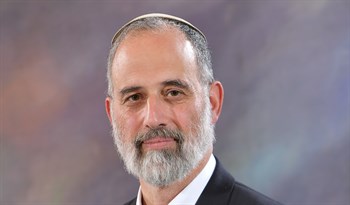
Rabbi Daniel Mann
339 - Walking in Israel
340 - Continuing to Eat a Seuda Shlishit without Bread
341 - Bar Metzra
Load More
May one continue when he has started eating but it is not a classic Shabbat meal, which must begin with bread and end with Birkat Hamazon (see Shulchan Aruch, OC 188:6-7)? The K’tzot Hashulchan (94, BHS 3) says that anything less than a proper meal is not the type of eating that allows one to continue. The Aruch Hashulchan (OC 299:5) adds that the fact that one did not wash and have bread shows that he did not consider it important enough. The Shevet Halevi (VIII, 36) seems to disagree, positing that any food that one eats in order to fulfill the mitzva of seuda shlishit has importance, and that status determines the matter of continuing. Rav Abba Shaul (Ohr L’Tzion II, 22:8) is lenient if one ate cake since eating a lot of cake constitutes a full meal regarding Birkat Hamazon. The Shemirat Shabbat K’hilchata (59:(47)) cites Rav S.Z. Auerbach as being unsure about this matter, but rules stringently even for one who was eating cake.
It is not clear to what extent all the above opinions disagree and how far each opinion goes, as we will explain. There are different opinions found in the Shulchan Aruch (OC 291:5) as to what one must eat for seuda shlishit. While the main opinion requires a bread meal, there are others: a mezonot food; meal-like foods; even fruit. It is possible that some of those who do not count cake were working with the assumption that this does not suffice for seuda shlishit, and cake lacks importance on its own merits. If you accept the opinion that it works for seuda shlishit, it is not unreasonable that it does for continuing as well. It is also possible that in contemporary society, in which many people rarely eat bread, other serious eating would also count. We would expect a consensus (it is not widely discussed) that a gluten intolerant person in the middle of an otherwise normal seuda shlishit would be able to continue. The idea that no bread is a sign of not having a set meal does not apply in these cases.
In the other direction, perhaps the Shevet Halevi allows continuing eating only the main food with which you want to fulfill the mitzva. This likely includes all the intended non-Mezonot food and drink to go along with the Mezonot food of a breadless meal. However, if one intends to fulfill the mitzva with cake more or less alone and then, for example, when a nice desert is served, one decides to have that too, it is likely not included. Thus, it is difficult to answer your question, as it lumps many possible scenarios together, and each has its own opinions and nuances.
It is certainly preferable to either eat bread or stop eating before shekia (or close to it – beyond our present scope). If you partake in a full meal but refrain from bread for a certain reason, leniency has strong grounds. If you are picking at food according to your mood, and even more so if you previously fulfilled seuda shlishit, it is difficult to allow eating as night approaches.


Rabbis in Midrash























Lessons
fast navigation










Israel and the Nations A Few Minutes & Many Innovative Ideas on Antisemitism & What to do About It
As we approach the High Holidays, this short lecture (18 minutes) deals with the unfortunate situation of how Israel and the Jewish People stand against antisemitism, analyzing its cause according to Rav Kook, and how to deal with the issue pragmatically & via our prayers.
Ha'azinu PURSUIT is PERFECTION
p. Ha'azinu, Shabbat Shuva
Rav Kook deals with the question of the seemingly hopeless nature of Tshuva. For G-d Himself knows that He created us with free will, which inevitably means we will sometimes make mistakes and choose wrong. This can easily be frustrating, freezing us into inaction and ye'ush (loss of hope). If one sins even once, does he chalila have no choice but suicide?! Moreover, our Godly conscience demands justice, righteousness and perfection, but we all know this is impossible, so what's the solution? Rav Kook's innovative thinking, strongly based on chazal (our sages), offers an inciteful and important aspect to this topic, especially this time of year!
Sukkot Bug-Free Sukkah: Essential Halachic and Practical Schach Guide
How to inspect, clean, and store bamboo mats and palm branches to protect your mitzvah and holiday meals.