Yeshiva
Beit Midrash
- Torah Portion and Tanach
- Shmot
- Tetzave

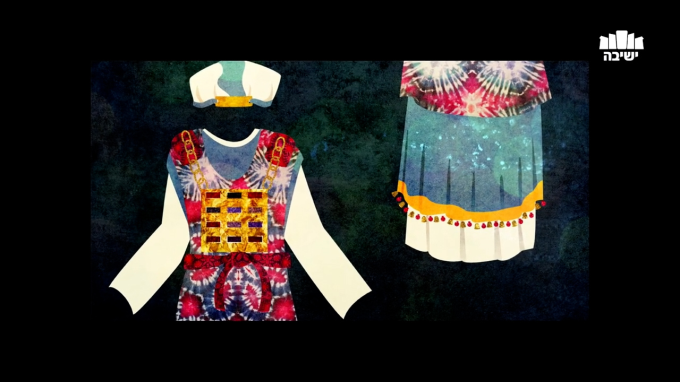
Kohen had a special significance to it, & also served to inspire the community to higher levels of devotion to Hashem.
For example, the Choshen, (breastplate), which attached to the vest or apron-like Ephod, had 12 precious gems upon it: Ruby, emerald, topaz, carbuncle, sapphire, beryl, jacinth, agate, amethyst, amber/aquamarine, onyx & jasper (per Rav Aryeh Kaplan in The Living Torah). These gems, representing the 12 Tribes, symbolized that each & every Jew was precious to G-d.
Interestingly, Purim, which we will soon celebrate, also has a very strong connection to clothes. Of course, the main one is that we wear all manner of costumes & somewhat outlandish outfits, out of a sense of heightened festivity, as well as to mimic Esther, who "masked" her identity and lineage; Mordechai, who concealed the fact that he & Esther were (according to Gemara Megila) married to each other, & the "hiddeness" of G-d in the story’s events (Hashem's name is also not mentioned directly in Megilat Esther).
But note, too, that the Megila begins when Achashverosh wears the clothes of the Kohen Gadol, mocking the sad state of post-Churban Jewry; Haman has an idol stitched into his clothes (one reason why Mordechai doesn’t bow to him);
and later in the story, Mordechai will wear both sack-cloth & ashes, as well as royal robes (& possibly a crown).
So, having said all this, what is the deeper idea behind clothes?
Many sources remark that the Hebrew word for clothes is "Beged," related to "boged" or "betrayal." This hearkens back to Gan Eden, where Adam & Chava, originally naked, were ashamed after their sin & so attempted a "cover-up" by donning clothes. Clothes can serve to focus our attention on externals, rather than the inner, most vital essence of a person. As such, they "betray" what’s really most important – the neshama of each one of us.
But as we see from Purim & our parsha, clothes also can reflect our spiritual status, our mission, our mood, our modesty, our moral bearing. Clothes are like a sign that proclaims to the outside world - & to us, as well – "Herein Resides a Jew!" Do we have a positive self-view? Do we respect the "space" – even in a visual sense – of others? Do we project ourselves as royal princes & princesses of Hashem, while at the same time maintaining the role of respectful,
un-conceited, humble servants of the Almighty?
It’s a "clothes-call" but it's one we make each and every time we dress.
Rabbi Stewart Weiss
Was ordained at the Hebrew Theological College in Skokie, Illinois, and led congregations in Chicago and Dallas prior to making Aliyah in 1992. He directs the Jewish Outreach Center in Ra'anana, helping to facilitate the spiritual absorption of new olim.
Jewish Laws and Thoughts Shul “etiquette:” can we honor Hashem while respecting our fellow congregants?



Rabbis in Midrash























Lessons
fast navigation











Various Events FOR WHOM NOT TO VOTE
Rav Zvi Yehuda Kook stressed that Israeli politics is G-dly, so I have no problem answering this common question on a Torani blog. Also, Free-Will is a G-d-given right and obligation, to "destine one's fate" (R. Soloveichik, Kol Dodi Dofek, 67), so I obviously don't tell others how to vote. But once not a few (especially young) have already asked, a couple of personal words from experience and thoughts from chazal & Rav Kook which may be of help to others, mainly for whom NOT to vote.

P'ninat Mishpat Fallout from Failure to Install Elevator – part II
based on ruling 85007 of the Eretz Hemdah-Gazit Rabbinical Courts










