Yeshiva
Beit Midrash
- Torah Portion and Tanach
- Shmot
- Terumah
- Family and Society
- Jerusalem and The Holy Temple
- The Holy Temple - Beit Hamikdash

The Torah study is dedicatedin the memory of
Hana Bat Haim
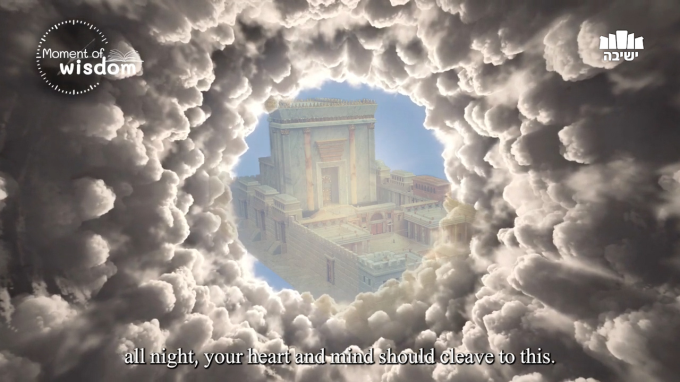
Let us compare this with the measurements of the Beit Hamikdash built by Shlomo to replace the Mishkan. In Melachim (I, 6: 2-20) it says that the Mikdash was 60 amot long, 20 amot wide, and 30 amot tall. The measurements of the Kodesh Hakodashim were 20 X 20 X 20. It appears that Shlomo built the Mikdash according to the instructions he received from his father, David Hamelech. It says in Divrei Hayamim (I, 28: 11,29) that David gave Shlomo the tavnit (blueprint) for the entire structure of the Mikdash in writing from the hands of Hashem. It also seems that David based himself on the prophesy he received in the house of Shmuel Hanavi, on the awesome night when Shmuel, Shaul, and David were engrossed in the idea of the Mikdash. The pasuk says: "And he (Shaul) went there to Nayot at Rama and he also had the spirit of Hashem upon him, and he went and prophesied until he came to Nayot at Rama. He also removed his clothes and prophesied before Shmuel" (Shmuel I 19: 23-24). The midrash asks why it mentions that David and Shmuel went to Nayot at Rama. What is the connection between the two? The midrash answers that they were sitting at Rama (Shmuel’s town) and dealing with the noy (beauty) of the world (the Mikdash) (Zevachim 54b).
It seems clear that Shlomo’s building of the Mikdash was well-planned and Divinely ordained. Shlomo doubled the measurements of the length and width of the Mishkan to make the Mikdash. What is strange is that the height of the Mikdash was tripled to 30 amot, not to 20 as we would have expected. (Shlomo kept the Kodesh Hakodashim as a perfect cube with each measure being of 20 amot.) The Malbim gives a very interesting interpretation. He says that Shlomo, through the volume of the Mishkan, wanted to make known the importance of unity among our nation. The Mishkan’s volume was 3000 cubic amot and it was superceded by the Mikdash whose volume was 36,000 cubic amot (60 X 20 X 30), the difference being a factor of twelve. This relationship teaches us that all twelve tribes are equal partners in the Beit Hamikdash.
According to this approach, the Mikdash not only unifies the upper and lower worlds but it even unites all the holy tribes around it. When we pray for the rebuilding of the Beit Hamikdash, let us also keep in mind this aspect of the Beit Hamikdash - that we will again become a unified nation.







Rabbis in Midrash























Lessons
fast navigation











Various Events FOR WHOM NOT TO VOTE
Rav Zvi Yehuda Kook stressed that Israeli politics is G-dly, so I have no problem answering this common question on a Torani blog. Also, Free-Will is a G-d-given right and obligation, to "destine one's fate" (R. Soloveichik, Kol Dodi Dofek, 67), so I obviously don't tell others how to vote. But once not a few (especially young) have already asked, a couple of personal words from experience and thoughts from chazal & Rav Kook which may be of help to others, mainly for whom NOT to vote.

P'ninat Mishpat Fallout from Failure to Install Elevator – part II
based on ruling 85007 of the Eretz Hemdah-Gazit Rabbinical Courts






