Yeshiva
Beit Midrash
- Torah Portion and Tanach
- Bereshit
- Vayeshev

that iconic phrase from the 1967 movie "Cool
Hand Luke" could easily be the subtitle of
Parshat Vayeshev. Within 7 p’sukim (37:4-10) 4
different forms of the verbs we use for
communicating – Diber, Siper, Omer, Magid – appear no less than 8 times.
But the essential statement about communicating –
or the lack thereof - is made regarding Yosef’s
brothers: "V’lo yachlu dabru l’shalom;" they were
unable to speak peaceably to Yosef. There is a
hidden message here beneath the surface that
presages the brothers’ plan to kill Yosef (later amended to selling him).
When Jews take leave of one another, & wish them
the best, we say the phrase, "Lech L’Shalom, go
in Peace;" these were the parting words of Moshe
& Yitro after their pleasant encounter. The
"lamed" also infers movement, implying that the
journey will go on (as in "Kol Yisrael yesh
lachem chelek L’olam haba;" inferring one’s
journey in the next world is fluid &
never-ending, as it connects to the life & merit of those we leave behind).
"Lech B’Shalom," however, has a negative
connotation. These were the last words spoken
when David & Avshalom parted, leading to tragic
consequences. The prefix "bet" also can infer
staying in place, implying that no future
movement will occur. That is why the parting
words we direct to the deceased at a funeral, lo
aleynu, are "lech B’shalom" rather than "L’shalom."
And so when the pasuk says that Yosef’s brothers
could not say "L’shalom," the Torah is telling us
just how dismal the situation was within the
family. Even the simplest greeting was painful
for them to utter. And the implication is that
they used the other term, "B’shalom," hinting to
what they were plotting for Yosef.
Words are not frivolous things, they are not just
"air;" they have power, they make an impact, they
create reality in the universe. Just by saying
something, in Halacha, we bind ourselves to an
action & cannot easily, if ever, retract or remove those words.
Words are precious, very precious. Indeed, there
are those who sincerely believe that when we are
born, we are allotted a finite amount of words to
be used in our lifetime, & when they are
depleted, we die. And since we don’t know just
how many words we’re granted, we should use them sparingly & carefully.
The terrible sin committed by the brothers has
eternal consequences; it reverberates throughout
the generations, long after Yosef & his siblings
reunite. It is, say Chazal, the cause of our
being placed in servitude in Egypt. And it
reappears in the "Eleh Ezkera" account of the
martyrdom of the Asara Harugei Malchut, the
murder of the 10 sages we read of on Yom Kippur.
The brothers’ sin started with words; harsh,
unforgiving, words. Sadly, our own crisis taking
place today also began with words. We – also
brothers - broke into rival camps that descended
into shouting at one another, barely, rarely
listening to what the other was saying. Is it
surprising that our words morphed into actions &
that the war of words became just…..war.
So let’s change the paradigm: Speak well, and it will be well.
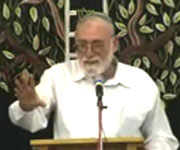
Rabbi Stewart Weiss
Was ordained at the Hebrew Theological College in Skokie, Illinois, and led congregations in Chicago and Dallas prior to making Aliyah in 1992. He directs the Jewish Outreach Center in Ra'anana, helping to facilitate the spiritual absorption of new olim.
Jewish Laws and Thoughts Shul “etiquette:” can we honor Hashem while respecting our fellow congregants?





Rabbis in Midrash























Lessons
fast navigation










Various Events FOR WHOM NOT TO VOTE
Rav Zvi Yehuda Kook stressed that Israeli politics is G-dly, so I have no problem answering this common question on a Torani blog. Also, Free-Will is a G-d-given right and obligation, to "destine one's fate" (R. Soloveichik, Kol Dodi Dofek, 67), so I obviously don't tell others how to vote. But once not a few (especially young) have already asked, a couple of personal words from experience and thoughts from chazal & Rav Kook which may be of help to others, mainly for whom NOT to vote.

P'ninat Mishpat Fallout from Failure to Install Elevator – part II
based on ruling 85007 of the Eretz Hemdah-Gazit Rabbinical Courts








