Yeshiva
Beit Midrash
- Torah Portion and Tanach
- Shmot
- Pkudei

Translated by Hillel Fendel
The Midrash (Sh'mot Rabba 52,2-5) tells us that when Moshe relayed to Israel G-d's command to build the Mishkan in which G-d's presence would dwell, the cynics of the generation mocked him. They said to each other: "Will G-d's presence truly dwell via the deeds of Amram's son? Can it be that a building constructed by mortal man would contain G-d's presence?" The cynics could not accept this.
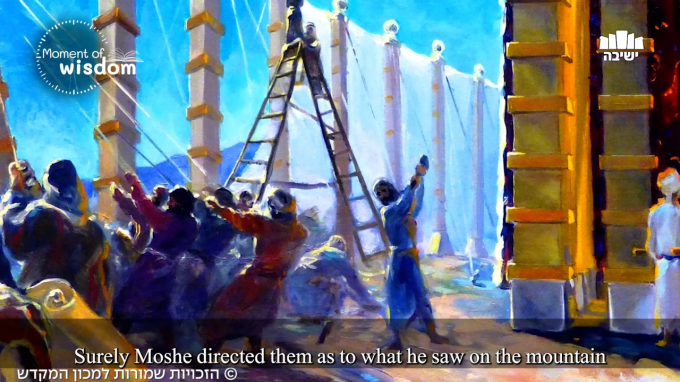
And in fact, when the artisans came to Moshe with their finished work, they froze, unable to actually erect the Mishkan. It could be that they were afraid to actually build it, lest the Divine Presence not actually dwell there and the Divine cloud not cover it (see Sh'mot 40,34). Who knows? Perhaps the work was not done with perfection or with the proper intentions? They were truly afraid, and did not want to build the Mishkan – for though they knew how to build its individual parts in the best way possible, perhaps all their work was for naught, as G-d might decide not to accept it?
They therefore brought it all to Moshe (Sh'mot 39,33), but they did not dare to take the final steps – and so Moshe himself erected the Mishkan. And when he did so, immediately, "The cloud covered the Tent of Meeting, and the glory of G-d filled the Tabernacle" (Sh'mot 40,34). What great joy there was that day, when they discovered that G-d was truly dwelling in their midst. The following verse in Song of Songs (3,11) was written about this day: "Go out and see, o daughters of Zion, King Solomon with the crown with which his mother crowned him on the day of his wedding and on the day of the happiness of his heart." The great joy on this day of the establishment of the Mishkan was when it was known that G-d dwelled in their midst.
If the Tabernacle had been built and the Shechina would not have dwelled in it, it would have been like a body without a soul. All its beauty and glory would be pointless; all the gold, silver and precious stones adorning it would have been mere external trappings – shiny, but without their true meaning and essence. It would have had everything, and it would have had nothing; the soul would have been lacking. Without an internal Holy Temple, without spiritual value and sanctity, life is shallow, superficial, like a dead body without the soul of life. What worth is there to wealth and gold and financial stability and a large house, if the Divine Presence does not dwell within it, and if there is no kindness, charity, and peace?
But when the material tools are used to serve virtuous spiritual purposes, then the shining light of the gold and silver is truly worth much, illuminating like the shine of the heavens, light of holiness and sanctity: the Divine Presence dwells within it. How fortunate are those who merit it!
In order to get articles like this delivered straight to your inbox every week, subscribe to the Israel National Torah newsletter here.
The Midrash (Sh'mot Rabba 52,2-5) tells us that when Moshe relayed to Israel G-d's command to build the Mishkan in which G-d's presence would dwell, the cynics of the generation mocked him. They said to each other: "Will G-d's presence truly dwell via the deeds of Amram's son? Can it be that a building constructed by mortal man would contain G-d's presence?" The cynics could not accept this.
And in fact, when the artisans came to Moshe with their finished work, they froze, unable to actually erect the Mishkan. It could be that they were afraid to actually build it, lest the Divine Presence not actually dwell there and the Divine cloud not cover it (see Sh'mot 40,34). Who knows? Perhaps the work was not done with perfection or with the proper intentions? They were truly afraid, and did not want to build the Mishkan – for though they knew how to build its individual parts in the best way possible, perhaps all their work was for naught, as G-d might decide not to accept it?
They therefore brought it all to Moshe (Sh'mot 39,33), but they did not dare to take the final steps – and so Moshe himself erected the Mishkan. And when he did so, immediately, "The cloud covered the Tent of Meeting, and the glory of G-d filled the Tabernacle" (Sh'mot 40,34). What great joy there was that day, when they discovered that G-d was truly dwelling in their midst. The following verse in Song of Songs (3,11) was written about this day: "Go out and see, o daughters of Zion, King Solomon with the crown with which his mother crowned him on the day of his wedding and on the day of the happiness of his heart." The great joy on this day of the establishment of the Mishkan was when it was known that G-d dwelled in their midst.
If the Tabernacle had been built and the Shechina would not have dwelled in it, it would have been like a body without a soul. All its beauty and glory would be pointless; all the gold, silver and precious stones adorning it would have been mere external trappings – shiny, but without their true meaning and essence. It would have had everything, and it would have had nothing; the soul would have been lacking. Without an internal Holy Temple, without spiritual value and sanctity, life is shallow, superficial, like a dead body without the soul of life. What worth is there to wealth and gold and financial stability and a large house, if the Divine Presence does not dwell within it, and if there is no kindness, charity, and peace?
But when the material tools are used to serve virtuous spiritual purposes, then the shining light of the gold and silver is truly worth much, illuminating like the shine of the heavens, light of holiness and sanctity: the Divine Presence dwells within it. How fortunate are those who merit it!
In order to get articles like this delivered straight to your inbox every week, subscribe to the Israel National Torah newsletter here.








Rabbis in Midrash























Lessons
fast navigation










Hosha'ana Rabba FLYDUBAI & HOSHANA RABBA- ANI VAHU HOSHIA NA- I & HIM SAVE US
"Ani vaHu Hoshia Na", "I and Him, Save Us". We don't just pray to Him, but we also pray to and for ourselves that we should emulate and educate our children to have that instinctive altruism with which He created the world. President Trump seemed amused about Yaniv Hayon, our PLUMBER who confidently worked with G-d like Superman (he learned from a pilot on a TV show!) to save 174 lives on the Dubai hijacking, but we in Israel are totally accustomed already 78 years to our plumbers, teachers, garbage-men, rabbis, farmers & doctors being Hashem's shlichim! This is what Zionism is about.
Moreshet Shaul Hashem Is your Shadow – part I
Based on Siach Shaul, Pirkei Machshava V’Hadracha p. 420 – an address from 1941









