YeshivaThe torah world Gateway
Beit Midrash
- Shabbat and Holidays
- The Three Weeks
- The 17th of Tamuz

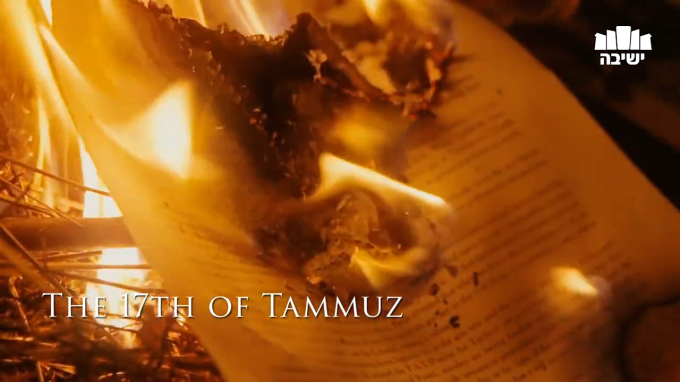
At first glance, it seems that the purpose of the month of Tamuz is to make us depressed. Although this month opens the summer vacation (a point to its credit), it contains all the components that create a sense of 'bummer': the start of the Three Weeks, scorching weather, and the fatigue that comes with the end of the year. In the book of Ezekiel, Tamuz was the name of an idol with lead eyes, which was worshipped by the burning of a near-by fire, which caused the illusion of tears flowing from its eyes. This spectacle provoked a cult of collective crying by all those present.
What is crying? When there is an encounter with a 'great' reality like the bright light of the sun - a curtain goes down, the eyes tear up and are covered with fog, an opportunity for introspection that helps absorption of the immense light is created. When one encounters an emotional reality beyond his ability of absorption – either tremendous joy or contrastingly, great sorrow - the tears accumulate. God has embedded a biological mechanism in us that helps to face extreme emotional feelings, which helps to absorb, precisely because of the limitation, the visible light in good news or what is hidden in bad news.
There are two Tamuz-like ways of dealing with life. Two worldviews that confront the infinite magnitude of the (sometimes negative) reality that is exposed to our eyes. One is the pagan way reflected in the cult of Tamuz: helplessness, an evil eye, despair, pessimism, crying as a goal in itself, crying for the sake of crying - "And most nations in their riddles and songs say that the evils of time are many and constant" (Malbim on Job 2:11). The second way is the Israeli way: crying as a means, the understanding that "God saw the light that it was good" (Genesis 1:4) - reality as a whole is full of light, while the moments of darkness, the moments of crying, are only a means of revealing the hidden inner goodness.
It is precisely in the month of Tamuz, when the sun shines strongly and the pagans found an outlet for their sense of frustration - the people of Israel are wise enough to deal with the reality of destruction. Coping with the understanding that sometimes, in order to reach the hidden light, one has to go through a dark period. " So said God of Hosts, the fourth fast…will become joy and happiness and good holidays for the House of Judea" (Zechariya 8, 19). Amen.
May this be a good month!



Rabbis in Midrash























Lessons
fast navigation











P'ninat Mishpat A Non-Contractor in Changing Times – part II
(based on ruling 85128 of the Eretz Hemdah-Gazit Rabbinical Courts)
Moreshet Shaul Hashem Is your Shadow – part II
Based on Siach Shaul, Pirkei Machshava V’Hadracha p. 420 – an address from 1941
Parashat Hashavua Happiness for the Right Reasons
[With painful longing, we share these divrei Torah from our co-Rosh Kollel for close to 40 years, Harav Moshe Ehrenreich zt”l.]

Israel and the Nations A Few Minutes & Many Innovative Ideas on Antisemitism & What to do About It
As we approach the High Holidays, this short lecture (18 minutes) deals with the unfortunate situation of how Israel and the Jewish People stand against antisemitism, analyzing its cause according to Rav Kook, and how to deal with the issue pragmatically & via our prayers.
Ha'azinu PURSUIT is PERFECTION
p. Ha'azinu, Shabbat Shuva
Rav Kook deals with the question of the seemingly hopeless nature of Tshuva. For G-d Himself knows that He created us with free will, which inevitably means we will sometimes make mistakes and choose wrong. This can easily be frustrating, freezing us into inaction and ye'ush (loss of hope). If one sins even once, does he chalila have no choice but suicide?! Moreover, our Godly conscience demands justice, righteousness and perfection, but we all know this is impossible, so what's the solution? Rav Kook's innovative thinking, strongly based on chazal (our sages), offers an inciteful and important aspect to this topic, especially this time of year!
Sukkot Bug-Free Sukkah: Essential Halachic and Practical Schach Guide
How to inspect, clean, and store bamboo mats and palm branches to protect your mitzvah and holiday meals.