Yeshiva
Beit Midrash
- Torah Portion and Tanach
- Shmot
- Tetzave

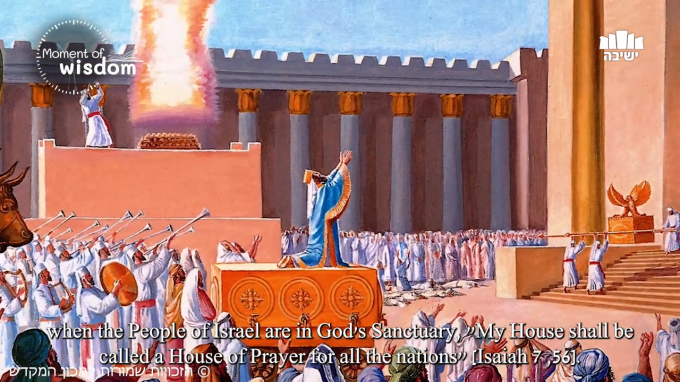
And yet, in our Sedra, the Torah seems to place great emphasis on more elaborate dress. The Kohanim – in particular the Kohen Gadol – had unique, carefully chosen clothes that were an integral part of their holy service to G-d & on behalf of the nation. If he neglected to wear even one of his special garments, the Kohen Gadol not only failed, but was subject to serious punishment. What messages were these unique clothes sending, & why are they still relevant to us, long after the service in the Bet HaMikdash ceased to be performed?
I want to suggest 3 ideas embodied within the clothes. The first is conveyed via the Avnei Shoham - the gold settings on the shoulder straps of the apron-like Ephod - & the jewels on the Ephod’s breastplate, or Choshen, which was worn "upon" the Kohen Gadol’s heart. Both of these items had the names of the 12 Tribes inscribed upon them, & both, says the Torah, were "l’Zikaron," to stir the memory of the Kohen Gadol. What memory was that?
He was to remember that, as our spiritual leader, he represented all the members of the nation – young & old, rich & poor, famous & nondescript. He was to carry the responsibility for their well-being on his shoulders, & keep their welfare close to his heart. For each & every one of them was golden, a precious gem in the eyes of Hashem.
The Torah also tells us, on several occasions, that the special clothes served "to fill the hands" of the wearer ("L’milay et yadam"). This unusual phrase tells us that a leader customarily held some object in his hand, such as Moshe with his staff, or a king with his scepter. But a deeper meaning is that if you want to lead a nation, be prepared to always "have your hands full" of tasks & trauma – & you had better be prepared to "hand"le it.
Finally, the clothes as a whole are designed "L’Chavod u’l’Tiferet" – for honor & for glory. The Malbim suggests that "honor" was due to the Kohen, or leader, strictly because of his lofty position. But the "glory" he earned was a result of his performance & how he utilized his position, employing his talents & energy to further the good of the people.
The era of the Kohanim & their leadership may, at least temporarily, be gone; but our present-day leaders - or would-be leaders - can take a lesson from our Sedra. They, too, must put the nation’s needs before their own & work hard to represent us with pride & dignity. Then, G-d willing, their success will be our success – Case Clothed.









Rabbis in Midrash























Lessons
fast navigation











Various Events FOR WHOM NOT TO VOTE
Rav Zvi Yehuda Kook stressed that Israeli politics is G-dly, so I have no problem answering this common question on a Torani blog. Also, Free-Will is a G-d-given right and obligation, to "destine one's fate" (R. Soloveichik, Kol Dodi Dofek, 67), so I obviously don't tell others how to vote. But once not a few (especially young) have already asked, a couple of personal words from experience and thoughts from chazal & Rav Kook which may be of help to others, mainly for whom NOT to vote.

P'ninat Mishpat Fallout from Failure to Install Elevator – part II
based on ruling 85007 of the Eretz Hemdah-Gazit Rabbinical Courts







