Yeshiva
Beit Midrash
- Torah Portion and Tanach
- Vayikra
- Bechukotai

The Torah study is dedicatedin the memory of
Asher Ben Haim
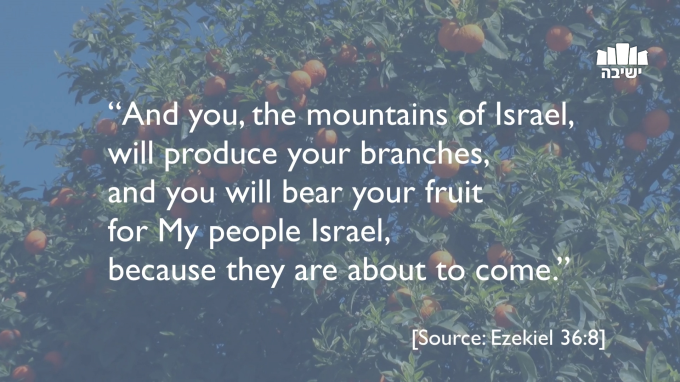
On the other hand, we see that the Land’s lot is tied up with our welfare as well. Rashi (ibid.:32) explains the pasuk "I shall make the Land desolate" as a favor for Bnei Yisrael, that other nations would not have success with the Land in our absence, apparently in order to make our return easier. The Land, which was commanded at creation to give fruit, remains a wasteland, in deference to a nation that does not even merit staying in the Land. So what does the Land want, and what are its rights?
Perhaps the key to this issue is found in Midrash Rabba (Vayikra 36:5) on the pasuk of remembering the patriarchs and the Land. The midrash compares the situation to that of a king who has three sons who are raised by one of his maids. When the king inquires as to the welfare of the children, he inquires about the maid’s welfare as well. In other words, the Land is the nation’s responsible caregiver, but it does not have special, individual rights. Its prominence comes from its ability to "raise" the nation.
Yet the midrash refers to the maid as "one of his maids." In other words, she was not there for the children to stomp all over. Rather, she represented the king and the extent to which they respected her authority was indicative of the respect the children showed their father, the king. Such is the relationship between Bnei Yisrael and Eretz Yisrael. It is to raise us and we are to respect the boundaries Hashem put on our use of it. If we abuse it or abuse His authority in other ways, the Land will spit us out (see Vayikra 18:25). Yet, Eretz Yisrael will not flourish when the evil children are sent away. Rather, it is set aside for the time that it will be able to raise Bnei Yisrael once again. Any other use of it would be a demotion from its past and future high station.
Let us pray that the reunion between the nation and the Land continue in full force and strengthen, as we use it to better serve our and its Maker.






Rabbis in Midrash























Lessons
fast navigation











Various Events FOR WHOM NOT TO VOTE
Rav Zvi Yehuda Kook stressed that Israeli politics is G-dly, so I have no problem answering this common question on a Torani blog. Also, Free-Will is a G-d-given right and obligation, to "destine one's fate" (R. Soloveichik, Kol Dodi Dofek, 67), so I obviously don't tell others how to vote. But once not a few (especially young) have already asked, a couple of personal words from experience and thoughts from chazal & Rav Kook which may be of help to others, mainly for whom NOT to vote.

P'ninat Mishpat Fallout from Failure to Install Elevator – part II
based on ruling 85007 of the Eretz Hemdah-Gazit Rabbinical Courts







