YeshivaThe torah world Gateway
Beit Midrash
- Torah Portion and Tanach
- Bereshit
- Vayishlach
- Sections
- Chemdat Yamim
- Parashat Hashavua
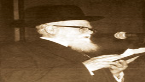
With a trembling of happiness and pain, we open this conference with the words of Yaakov Avinu from this week’s parasha – "I am small in relation to all of the kindnesses … now I make up two encampments" (Bereishit 32:11). The small group of members who came to a barren location and started weeding out the wild grass did not dream that in such a small amount of time, this place would turn into a center to which people look. We are now two encampments – an agricultural village and a yeshiva.
However, we remember the factor that brought this whole group here [to commemorate], for there has not passed a special amount of time from the close of Volozhin. What is new is that until now, the continuation of Volozhin was living in the form of various yeshivot in Israel and in the Diaspora. But now, when we are missing all of those yeshivot (in the midst of the Holocaust), we feel a need to recall and eternalize the memory of that great house, which gave us so much.
We read in the parasha: "Yaakov was left alone, and a man struggled with him until the break of dawn" (ibid. 25). On the verge of entering Eretz Yisrael, there was an unavoidable encounter between opposing forces, Yaakov and Eisav. As much as Yaakov tried to avoid it, taking a circuitous route and side roads, the time of the meeting came. The encounter was between the tzaddik, who was always ready to compromise and allowed himself to be pushed to the side, and between the haughty rasha, who acted with spite and animosity. The struggle was necessary for both of them, as only through it did the angel of Eisav arrive at the goal of his life: "Let me go, for dawn has broken," which Chazal say meant that this was the first time that he was called to sing praises to Hashem (Chulin 91b). Similarly, it is only at this encounter that Yaakov Avinu received his name, which our nation has adopted, Yisrael. In Hashem’s secret world plan, there is a task for evil to perform, with all of its disgustingness and haughtiness, to agitate goodness and turn it into a fighter, even a vengeance-seeking power, brazen in its opposition to evil.
It is so tragic that specifically at this critical moment in time, for which Yaakov was preparing his whole life, after having trained his sons, and especially his closest son, Yosef the Tzaddik, who was uniquely empowered to fight the negative spiritual side of Eisav, that Yaakov was left alone without the help of his children. He was involved in retrieving small vessels that were left behind. On the one hand, the righteous can be proud of their material possessions, as they are all things that were obtained without theft (Psikta Zutrata 32:33), but they are still things that look trivial at a moment of eternal importance. Indeed, that is why Yaakov had to come out of this encounter limping.
In regard to the competition between powerful forces at the era leading up to the coming of Mashiach, the intention of the Yeshiva of Volozhin was to prepare the forces for this critical time. Its goal was to strengthen the young generation so that the old generation would not have to stand alone in its struggle against evil. Rather, the sons would also be able to add their part to the battle.



Rabbis in Midrash



















Lessons
fast navigation











Sukkot Bug-Free Sukkah: Essential Halachic and Practical Schach Guide
How to inspect, clean, and store bamboo mats and palm branches to protect your mitzvah and holiday meals.

Shoftim TESHUVA IN COURT OF LAW?
Parshat Shoftim-Chodesh Elul
Why does parshat Shoftim always come out during Elul? This innovative and central explanation is an eye-opener regarding many aspects of Judaism.

The Month of Elul TESHUVA IS THE ANSWER
The month of Elul serves as a vital time for self-reflection and personal accountability to prepare for true repentance.
P'ninat Mishpat P'ninat Mishpat: Realtor’s Fee on Large Commercial Building – part I
(based on ruling 85031 of the Eretz Hemdah-Gazit Rabbinical Courts)
(based on ruling 85031 of the Eretz Hemdah-Gazit Rabbinical Courts)