YeshivaThe torah world Gateway
Beit Midrash
- Torah Portion and Tanach
- Shmot
- Yitro

We begin with a story: A man goes to his doctor's home for an emergency visit. Upon entering the yard, he sees a large sign: "Caution, dog in the yard." Step by careful step, the man – who was afraid of dogs – makes his way gingerly in, trembling with fear, looking in all directions for a dog that might pounce on him at any moment. Suddenly, a tiny little poodle comes out, wagging his tail innocently. The relieved man enters the doctor's office and asks, "Why do you need a warning sign for such a tiny dog?" The doctor answers, "Do you know how many people stepped on the dog before I put up that sign?!"
Which leads us to these questions: Why do many Torah speakers begin their talk with a joke, and why does the Gemara (Shabbat 30a) say that it is good to begin a Torah class with words of humor (see Rashi there)?
The Gemara states that "the Divine Presence dwells not amid sadness or laziness, etc., but only amidst the joy of doing a mitzvah." Rav Yehuda adds there that this applies not only to the dwelling of the Shechina, but that every Torah class should begin with some humor. Rabba was known to begin his classes with humor, and would then proceed with fear of G-d as he delivered his lecture.
However, this approach does not go unchallenged. The Gemara tells us that Rav Gidel said in the name of Rav that any student who "sits before his teacher and his lips do not drip with myrrh due to fear of his teacher, those lips shall be burnt" [as derived homiletically from Song of Songs 5,13)."
These two seemingly contradictory approaches are resolved in two ways:
The first is that when referring to the teacher, the study must begin on a light note, for he must be happy with his Torah study, but a student must learn from his teacher with solemnity.
A second answer is that the class can begin with humor, but must continue with seriousness and concentration.
Rav Kook explains (in his commentary on the Aggadic portions of Tractates B'rachot and Shabbat, entitled Ein Ayah) as follows:
"G-d created man upright [straight]" (Kohelet 7,29). By our nature we are perfectly attuned to and in sync with Torah study, and we are naturally inclined to love the Torah and its mitzvot. As such, our every encounter with Torah would naturally be gladdening and enjoyable, and something that we would always look forward to. However, today that is not necessarily the case. Our natural inclinations have been muddied by our sins, and too often we seek out only the physical pleasures of life, those in contrast with the holy and spiritual. When this approach encounters the Torah, not only is there no enjoyment, but there can even be the opposite, blocking us from being filled with the richness of Torah.
But all that is just at the beginning of Torah study, or at a "new" beginning after a break or even a retreat from Torah learning and experience. At these times, if we engage in Torah with labor and toil, it will sanctify us and will enable us to be filled with spirituality – thus restoring us gradually to our original state of natural purity and sanctity. Once again, then, we will enjoy studying the words of G-d. At first, toil is needed, with persistence and hardship, even when it is not pleasurable. But slowly, the soul will be purified, and the enjoyment and longing for Torah study and mitzvot will return.
This is why the Gemara differentiates between the teacher and the pupil. The former is already on a very positive level in his Torah study and enjoys it profusely – but the student is not yet there; he is still at the beginning, and must work hard. If it comes too easily, it won't last, and he won't be able to truly acquire the Torah.
G-d told the Children of Israel before the Stand at Mt. Sinai: "V'atah im shamo'a tishm'u…", which means, "And now, if you hearken to My voice…" Rashi explains this verse to mean: "If you now take upon yourselves the Torah, it will be joyful for you from then on – because all beginnings are hard."
Similarly does the Ohr HaChaim explain the double language in the same verse: Im shamo'a tishm'u, meaning literally, "if hear you will hear." He says, "If you start off hearing and abiding by the Torah, then you will want to hear more; this is why G-d says here, 'If you hear now, you will see how pleasant it is, and I promise that you will then want to continue to hear, of your own volition – as is written (Tehillim 34,9), 'Taste and see that G-d is good.'"
Rav Kook further explains there that there are those who feel that young pupils should be taught Torah in an entertaining manner – what we today see in games, contests, colorful worksheets, cartoons, and the like. However, he writes, "not in this way will wisdom enter their hearts." If someone seeks to learn because it is something enjoyable, it means he is focusing on the externals of Torah, and in the end, he will not truly acquire it. Hard work is needed in order to begin learning, and hard work does not go together with one's desire to be happy; the sweetness that exists naturally in Torah will become bitter, and his learning will not bear fruit.
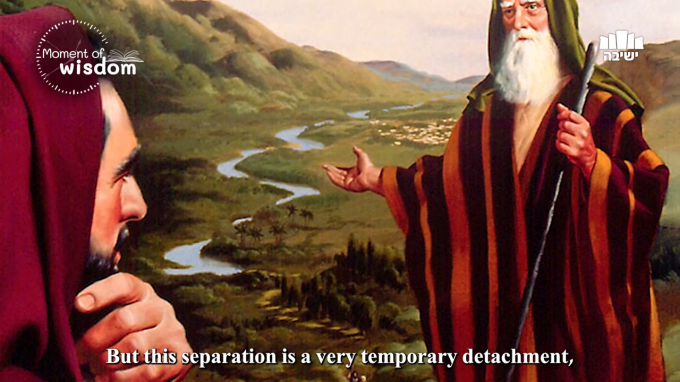
But this does not mean that Torah cannot come with joy, festive meals, and music. The Prophet Elisha specifically asked for music, to enable him to receive prophecy. The famous Torah commentator Rabbeinu Bachye explains that this is also the essence of the meal that Moshe Rabbeinu enjoyed with his father-in-law in the beginning of this week's Torah portion of Yitro [Sh'mot, chapters 18-20]. Aharon and the elders of Israel also participated in this feast, and Rabbeinu Bachye writes that its purpose was to increase joy in their hearts so that the Holy Spirit would rest upon them – for the powers of the soul are linked with the powers of the body.
Similarly, Yitzchak Avinu asked his son to prepare him tasty food before he blesses him.
Torah learning can increase and bring enjoyment – but it cannot start off that way.
Translated by Hillel Fendel




Rabbis in Midrash


































Israel and the Nations A Few Minutes & Many Innovative Ideas on Antisemitism & What to do About It
As we approach the High Holidays, this short lecture (18 minutes) deals with the unfortunate situation of how Israel and the Jewish People stand against antisemitism, analyzing its cause according to Rav Kook, and how to deal with the issue pragmatically & via our prayers.
Ha'azinu PURSUIT is PERFECTION
p. Ha'azinu, Shabbat Shuva
Rav Kook deals with the question of the seemingly hopeless nature of Tshuva. For G-d Himself knows that He created us with free will, which inevitably means we will sometimes make mistakes and choose wrong. This can easily be frustrating, freezing us into inaction and ye'ush (loss of hope). If one sins even once, does he chalila have no choice but suicide?! Moreover, our Godly conscience demands justice, righteousness and perfection, but we all know this is impossible, so what's the solution? Rav Kook's innovative thinking, strongly based on chazal (our sages), offers an inciteful and important aspect to this topic, especially this time of year!

Sukkot Bug-Free Sukkah: Essential Halachic and Practical Schach Guide
How to inspect, clean, and store bamboo mats and palm branches to protect your mitzvah and holiday meals.