Yeshiva
Beit Midrash
- Torah Portion and Tanach
- Vayikra
- Behar

What do we learn from the prohibition on paying and taking interest?
This week's Torah portion of Behar (Vayikra 25,1-26,2) deals with several societal mitzvot, such as the Shmittah (the seventh-year fallow) and Yovel (Jubilee) years, the redemption of lands, and the ban on taking or paying interest. One of the words for interest is neshekh, from the same root as neshikha, bite. One who takes interest takes a "bite" from the live flesh of his borrower.
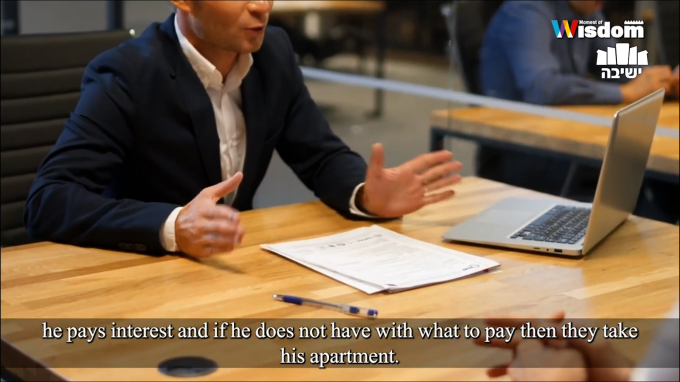
The Torah's prohibition on interest stems from a spiritual principle: One must not make easy profits at the expense of the weakness of the other. When a person lends money and charges interest, he is taking advantage of the borrower's neediness in order to make money off him. The profit here is not from creative work, but only on the "time" that the money is in the hands of the borrower.
Our Sages teach us here an important principle: The equation Time is Money is wrong; the correct one is Work equals Money! When one works and makes a profit, the work itself is productive, and the money is just a result – as opposed to one who lends money, where there is no productivity.
We did not come into this world in order to make easy money. Rather, we are here to create. We are here to form relationships with each other, where no one takes advantage of anyone else – and thus we constructively build the reality around us, for ourselves and others. This is also the reason why we have the mitzvot of Shmittah and Yovel: so that we can press restart on our social frameworks, and ensure that the gaps between people are not too large. If we succeed, the opportunities for one to take advantage of others are limited.
These are important principles to remember all year round, but they are all the more critical especially now, during the Counting of the Omer! This period is a time in which historically, R. Akiva's students were not sufficiently sensitive of their colleagues – and so we must make doubly sure not to repeat those mistakes today. It is therefore customary to study Pirkei Avot during these weeks, because the Mishnayot of Avot serve as an introduction to the laws of monetary matters, teaching us how to behave properly in our dealings with our fellow man.
Translated by Hillel Fendel








Rabbis in Midrash

































Hosha'ana Rabba FLYDUBAI & HOSHANA RABBA- ANI VAHU HOSHIA NA- I & HIM SAVE US
"Ani vaHu Hoshia Na", "I and Him, Save Us". We don't just pray to Him, but we also pray to and for ourselves that we should emulate and educate our children to have that instinctive altruism with which He created the world. President Trump seemed amused about Yaniv Hayon, our PLUMBER who confidently worked with G-d like Superman (he learned from a pilot on a TV show!) to save 174 lives on the Dubai hijacking, but we in Israel are totally accustomed already 78 years to our plumbers, teachers, garbage-men, rabbis, farmers & doctors being Hashem's shlichim! This is what Zionism is about.
Moreshet Shaul Hashem Is your Shadow – part I
Based on Siach Shaul, Pirkei Machshava V’Hadracha p. 420 – an address from 1941










