Yeshiva
Beit Midrash
- Shabbat and Holidays
- Sefirat Haomer
- The Meaning Sefirat Ha'omer

The Torah study is dedicatedin the memory of
Yaakov Ben Behora
Furthermore, R’ Yochanan says in the midrash: Never let the mitzvah of the omer be light in your eyes. Even though the omer comes from barley, which is animal fodder, one might consider it a mitzvah of low significance and therefore deal with it leniently. But Avraham Avinu only received the land in the merit of the omer, as it says, "And to you I gave this land" [on condition] "You keep my covenant," referring to the brit of the omer. In other words, Chazal here teach us that the omer is not simply a mitzvah, but a brit. A mitzvah with the status of brit influences all of the other 612 mitzvot, as indicated by brit’s gematria - 612. What is so special about the mitzvah of the omer that bestows upon it the status of brit? Other mitzvot with this status—milah, Shabbat, learning Torah—influence our lives in major ways. But why does omer receive this status as well?
The answers to these questions lie in the definition of the word omer. In Hebrew, the root omer has three definitions: 1) omer, a measurement - in the Desert, B’nei Yisrael were commanded to eat an omer of manna, one tenth of an eifah; 2) me’amer, gathering together twigs and the like - one of the 39 melachot prohibited on Shabbat; and 3) l’hitamer, to misuse an object in one’s possession - the Torah forbids one who takes an eishet yefat to’ar (the beautiful captive) in battle and decides not to marry her to keep her as a slave, saying, "lo titamer bah." These three definitions complement one another, providing a more accurate definition of omer.
During the forty years B’nei Yisrael traveled the Desert, the manna fell every day except Shabbat. Once they crossed the Jordan, the manna stopped and they no longer received their bread effortlessly, but became partners in its creation. Partnership with HaKadosh Baruch Hu is certainly advantageous, but contains a great risk as well. When a person toils and succeeds, he may mistakenly conclude that his own efforts caused his success, not any input from HaKadosh Baruch Hu.
The mitzvah of omer counteracts this misperception. The Torah commands us to sacrifice barley, animal fodder, so that we understand that even the lowliest of foods comes from HaKadosh Baruch Hu. In order to amplify this lesson, the Torah commands us to count up to the omer for 49 days. When a person lives in such a way, he can gather (me’amer) as much as he wants with no danger of misusing it (l’hitamer); quite the contrary, he will mete it out in proper measurements (omer).
This may be the depth behind the phrase "lichrot brit, to cut a deal." There is no greater oxymoron: lichrot means to sever, while a brit is something that connects. The idea is that the two parties to the brit must cede a little bit in order to receive. HaKadosh Baruch Hu desires to cede something to us, and He wants to cede even more. The more we use what we have properly, the more He desires to give us. The brit of the omer is therefore the brit through which Avraham Avinu merited Eretz Yisrael. To inherit the Land is only possible if we truly feel that everything not only came from Him, but continues to come from Him: "When you come to the land that I give you," in the present tense.
May Hashem grant us the ability to truly feel that everything emanates from Him, and through this may He grant us ever more.
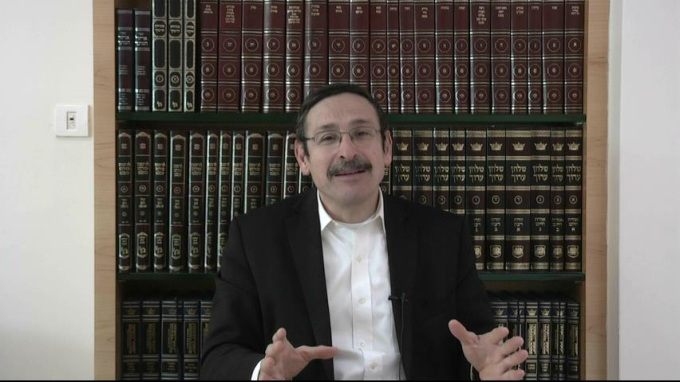



Ein Aya How Unclean Thoughts, Speech & Pornography Bring Depression & Loneliness
Ein Aya, Shabbat 2, 234






Rabbis in Midrash























Lessons
fast navigation









Various Events FOR WHOM NOT TO VOTE
Rav Zvi Yehuda Kook stressed that Israeli politics is G-dly, so I have no problem answering this common question on a Torani blog. Also, Free-Will is a G-d-given right and obligation, to "destine one's fate" (R. Soloveichik, Kol Dodi Dofek, 67), so I obviously don't tell others how to vote. But once not a few (especially young) have already asked, a couple of personal words from experience and thoughts from chazal & Rav Kook which may be of help to others, mainly for whom NOT to vote.

P'ninat Mishpat Fallout from Failure to Install Elevator – part II
based on ruling 85007 of the Eretz Hemdah-Gazit Rabbinical Courts






