Yeshiva
Beit Midrash
- Torah Portion and Tanach
- Bereshit
- Chayei Sara

But Yitzchak? He is dragged around throughout his entire life: first to the Akeida, then to the Chupa, then by his wife & kids - no wonder he lived in the city of G'rar, which means "dragged!" He seems to be distant, detached, depressed. And his name Yitzchak (laughter); what’s that about? This is a funny guy?! I don’t think so!
But, of course, I was naive. I misjudged Yitzchak. I didn’t quite get it. But now I think I do.
It starts with a pasuk in our Sedra, the very first time we encounter Yitzchak since the traumatic Akeida. The pasuk says: And Yitzchak went out in the field "lasuach." Rashi translates this word "la'suach" as praying; that is, Yitzchak was davening (by tradition, the evening/Maariv prayer). But if it means praying, then why not use the more obvious & common word, l’hitpalel?
No, the term clearly connects to the word "siyach," conversation. Yitz wasn’t just praying to G-d; he was also talking to Him! The Medrash, elsewhere, asks why all the Matriarchs (including Leah) were initially barren & struggleD to have children. The Medrash replies: "Hashem desires the prayer & the talk/siyach of the righteous." G-d knows that only in the depth of our despair can we utter our most sincere & heartfelt prayers to Him.
But prayer, my friends, is not enough. G-d also wants us to TALK to Him, to express our inner feelings & share our concerns, our thoughts on life, love, the world, on G-d. He cares about what we have to say! And though we Jews maybe great daveners, scrupulous in every syllable, we don’t often just pull up a chair & talk to G-d, who, after all, is a Great Listener who won’t get distracted or interrupt us!
Yitzchak has a lot to talk to G-d about. His mother is dead, his father took him to be sacrificed, & he came this close to death. He has trouble communicating with his wife, & massive problems with his kids (sound familiar?). So if he spends an inordinate amount of time praying, communing, beseeching & discussing with Hashem, can you blame him? The two of them have a lot to work out.
And so do we. There is a time to pray to G-d, & a time to close our Siddur & talk to Him. And I’m not sure which is more holy & valuable, & which He desires most. So, let’s do both! Talk - at least with G-d - is anything but cheap.
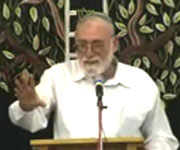
Rabbi Stewart Weiss
Was ordained at the Hebrew Theological College in Skokie, Illinois, and led congregations in Chicago and Dallas prior to making Aliyah in 1992. He directs the Jewish Outreach Center in Ra'anana, helping to facilitate the spiritual absorption of new olim.
Jewish Laws and Thoughts Shul “etiquette:” can we honor Hashem while respecting our fellow congregants?






Rabbis in Midrash























Lessons
fast navigation










Various Events FOR WHOM NOT TO VOTE
Rav Zvi Yehuda Kook stressed that Israeli politics is G-dly, so I have no problem answering this common question on a Torani blog. Also, Free-Will is a G-d-given right and obligation, to "destine one's fate" (R. Soloveichik, Kol Dodi Dofek, 67), so I obviously don't tell others how to vote. But once not a few (especially young) have already asked, a couple of personal words from experience and thoughts from chazal & Rav Kook which may be of help to others, mainly for whom NOT to vote.

P'ninat Mishpat Fallout from Failure to Install Elevator – part II
based on ruling 85007 of the Eretz Hemdah-Gazit Rabbinical Courts








